
Digital marketing is constantly changing to meet the needs of users, and the arrival of Covid 2020 has turned the digital marketplace upside down, with changes in blocking and shopping patterns, as well as causing some supply chain breakdowns and declining on-time delivery rates.
These changes have made digital marketing more important than ever, and clear digital marketing trends are becoming apparent in this post-Covid era.
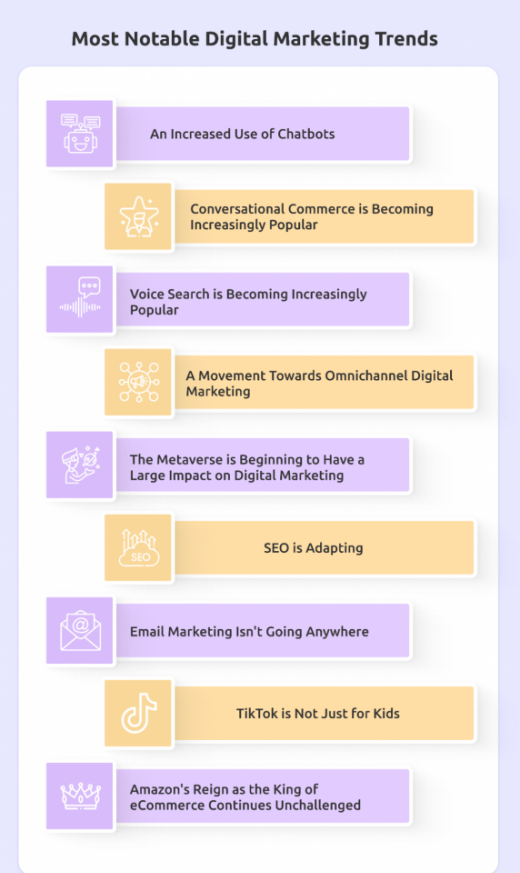
1. Increased use of chatbots
With more and more people conducting research online, coupled with the reluctance of many to visit a physical store, the use of chatbots has increased dramatically over the past few years.
Recently, chatbots have become more realistic, providing a much-improved user experience. In addition, advances in artificial intelligence (AI), machine learning (ML), natural language processing (NLP), and customer sentiment analysis have all improved the ability of chatbots to interact in a more human-like manner. As a result, companies are enhancing their customers’ customer service experience without a significant investment increase.
Tidio reports that 88% of customers have had at least 1 conversation with a chatbot in 2021. Their survey found that in addition to customer service and marketing, chatbots are used in other areas such as data collection, human resources and operations. They are now an attractive option for E-Commerce stores, B2B companies, real estate and even healthcare.
2. Business communication is becoming increasingly popular
The customer experience (CX) is becoming increasingly important. Many consumers are willing to pay more for goods and services if they receive a quality experience, rather than just looking at the lowest price, and business communications can help improve the customer experience.
Commerce communications (conversational marketing or chat commerce) uses communication platforms and messaging applications such as WhatsApp and Facebook Messenger to market products, communicate with consumers and support them at every stage of the sales funnel.
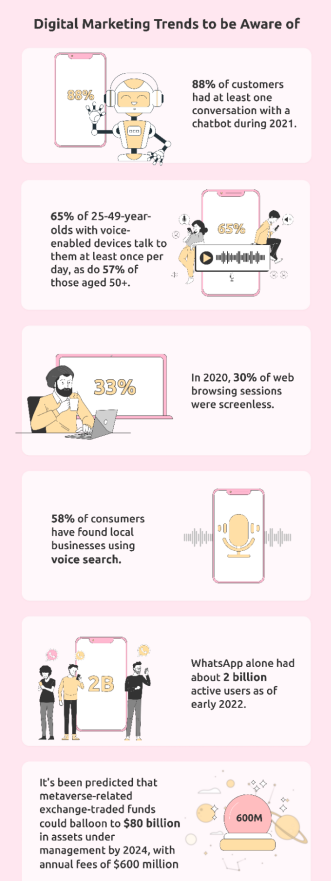
Many people regard communicating with brands in this way as a natural evolution, just as they do for many personal conversations. WhatsApp had about 2 billion active users by early 2022.
3. Voice search is becoming increasingly popular
It’s not just millennials who are discovering the convenience of voice search. For example, 65% of 25-49 years old who own a voice device talk to them at least once a day, as do 57% of those over the age of 50.
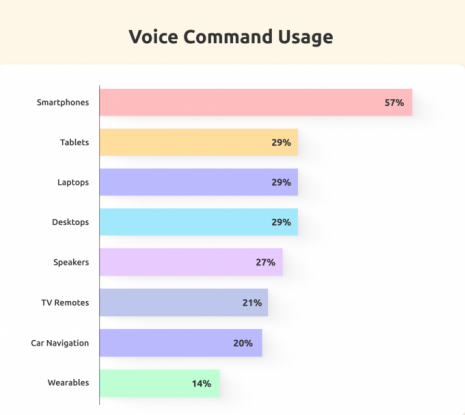
Gartner found that in 2020, 30% of Web browsing sessions will be screenless. This clearly demonstrates a shift in how consumers interact with brands online.
Voice search users are increasingly searching for local results. According to Google, searches for “near me” businesses have increased dramatically over the past few years. Google reports that 58% of consumers use voice search to find local businesses.
As a result, E-Commerce companies need to adjust their SEO to optimize voice search. Methods include using natural language to directly answer specific questions, pattern tagging and rich snippets, keeping listings and e-commerce store data up-to-date, and ensuring all content is optimized and up-to-date.
4. Omnichannel digital marketing campaigns
Digital marketing channel campaigns can bring benefits to brand marketing, which helps them reach a broader audience. In addition, most people are not limited to a single digital channel, and omnichannel marketing allows brands to take advantage of multiple channels.
The key to omnichannel marketing is to leverage all channels to create a unified experience for each customer. In fact, true omnichannel marketing is not limited to digital marketing. Instead, it includes a number of traditional marketing channels in its mix, recognizing that people are not yet 100% digital. Each channel interacts to create a unified voice and message for the brand.
Omnichannel marketing recognizes that consumers use a variety of channels at different stages of the day. For example, they may check Facebook before turning to Instagram. then they may check their email. At that point, it’s time to go to work and listen to the radio as they walk. On the way home, they might stop at the supermarket to check point-of-sale ads and listen to Spotify on the go. finally, they could spend the evening watching TV shows or surfing the web on their phone or tablet. This provides brands with many potential touchpoints to reach consumers with a unified but disparate message.
5. The metaverse is starting to have a major impact on digital marketing
In 2021, Facebook (the company) changed its name to Meta. separating the name of the platform and the company made sense given the size and reach of Facebook assets that were not Facebook (the platform). At the time of the name change, Mark Zuckerberg announced that the company would place its future on its meta-universe.
Virtual worlds include live entertainment, social networks, hardware, user-generated content and technology infrastructure. It is a shared virtual space where megatrends converge. It incorporates multiple virtual and augmented experiences. The Metaverse includes platforms such as Roblox, Minecraft and Fortnite.
As people spend more and more time in the virtual world, the line between the real world and the virtual world is becoming increasingly blurred. As a result, people are experiencing brands and even buying virtual products. For example, Vans has partnered with Roblox to create a virtual skate park. Here they can practice their virtual skateboarding skills and then buy Vans products without leaving the virtual world.
6. SEO methods are being optimized
Google is rolling out a major page experience update in 2021. This update integrates a new set of metrics called Core Web Vitals into what Google traditionally calls the “Page Experience.” Core Web Vitals are baseline requirements for the technical health of a website. They effectively measure the user experience (UX) of a web page and cover three main areas: loading, interactivity, and visual stability. These metrics measure how long it takes users to access your page, how easy it is for them to interact with it initially, and whether they are disoriented by inconsistencies in the page design.
Page experience updates combine core web vitality with more traditional factors such as mobile-friendliness, secure browsing, HTTPS (as opposed to HTTP-only), and the absence of intrusive interstitial ads.
Google has also emphasized the importance of the “people also ask” section of its search results. In fact, it now appears in about 48.6% of searches, usually prominently displayed above the first position in a search. Therefore, as a marketer, you should include answers to frequently asked questions in your content.
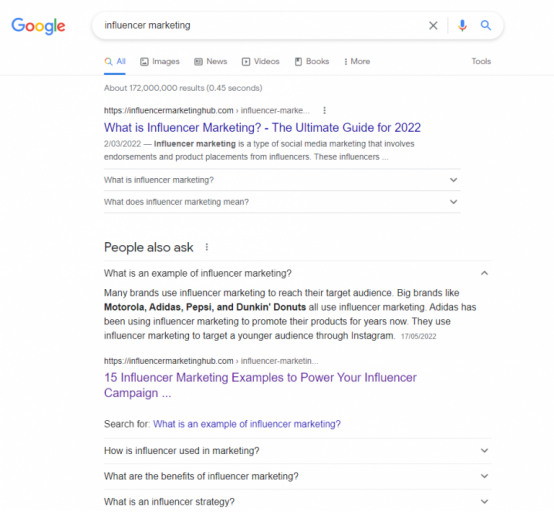
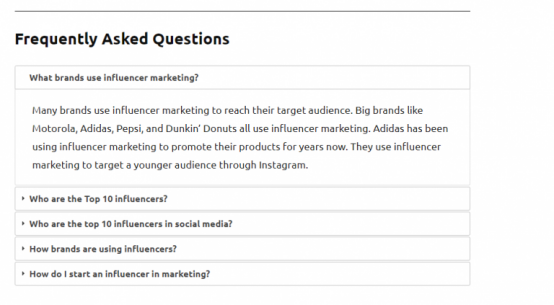
However, Google also includes a “People Also Ask” section where the first question is “What is an example of influencer marketing?” Google has selected a section from our 15 Influencer Marketing Examples FAQ to support your influencer marketing program as the best answer to this question. However, when you take a closer look at the post, you’ll see that the actual question in the FAQ is “Which brands use influencer marketing?” Although the wording is different, Google’s algorithm is smart enough to recognize the similarities between the two questions.
7. Personalized email marketing
Since email marketing is one of the oldest forms of digital marketing, people have been predicting for years that its demise might be inevitable. However, instead of what was predicted, email marketing is on the rise.
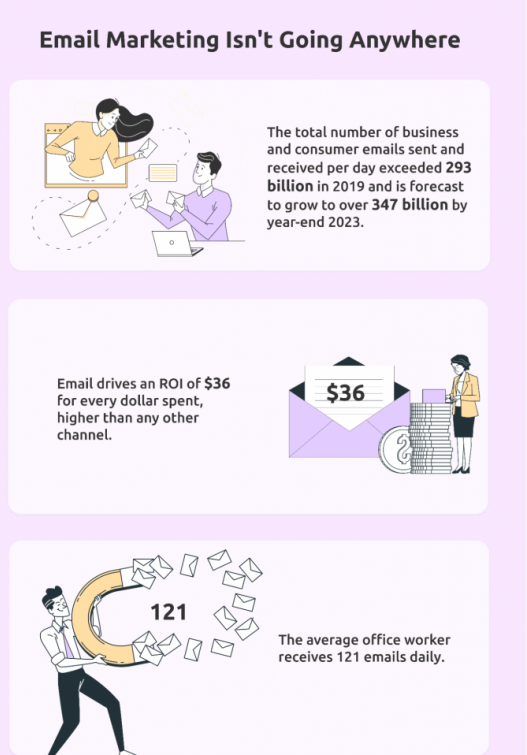
According to Radicati Group, the total number of business and consumer emails sent and received per day exceeded 293 billion in 2019 and is expected to grow to more than 347 billion by the end of 2023. By that time, global email users are expected to reach 4.3 billion over time. In addition, Litmus reports that email delivers a $36 ROI for every $1 spent, more than any other channel.
However, personalization is now critical to successful email marketing. People have to opt-in to email marketing and are very conscious of their privacy. As a result, they won’t accept generic, irrelevant emails. They receive a lot of emails every day – in fact, DMR reports that the average office worker receives 121 emails a day – so it takes something special to entice someone to open your email. Personalized marketing emails can help you increase their effectiveness. Some companies are now using artificial intelligence to create customized and tailored emails for specific customers.
8. TikTok's brand marketing
We’ve been covering the rise of TikTok since Musical.ly existed as a standalone platform. However, sometimes it’s hard to convince brands that it’s a serious social media platform. We’ll be updating our TikTok stats article regularly and noting how fast TikTok is growing in popularity.
If you’re still sceptical that TikTok is worthy of serious digital marketing, consider some of the following data.
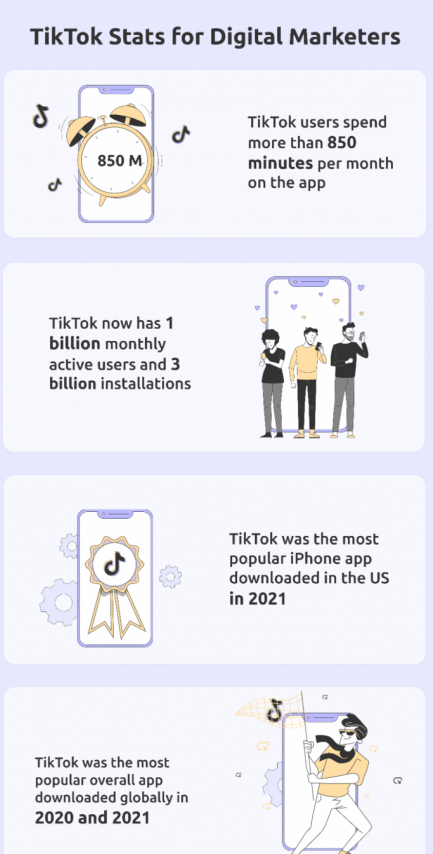
- TikTok users spend more than 850 minutes per month on the app
- TikTok now has 1 billion monthly active users and 3 billion installs
It is the most popular iPhone app downloaded in the U.S. in 2021, ahead of YouTube, Instagram, Snapchat and Facebook.
In fact, TikTok is the most downloaded overall app in the world in 2020 and 2021. Like Facebook (and Instagram), TikTok now has a formal advertising marketplace, making it easy for brands to place ads on the platform. TikTok is still most popular with millennials, with 32.5% of its U.S. users between the ages of 10-19, but its audience is ageing. TikTok users don’t seem to be “growing up” from the platform in the same way Facebook users grew up from the app.
9. Amazon continues to rule E-Commerce
Amazon continues to reign supreme as the leader in e-commerce. Although visitors to Amazon.com dropped to 2.2 billion in February 2022, this really just reflects a global reduction in blockades associated with the new crown virus, which has increased shoppers’ choices.
Ship2eu will support the fulfillment of your orders with fast and stable shipping time to EU countries, you can focus on advertising and we take care of other issues for you.